
Holy Eucharist
We celebrate our lives in Christ, proclaiming an authentic faith for real people. We proclaim God’s love for all through ritual, song, prayer, scripture, silence, beauty, and communion.
We celebrate our lives in Christ, proclaiming an authentic faith for real people. We proclaim God’s love for all through ritual, song, prayer, scripture, silence, beauty, and communion.
We celebrate our lives in Christ, proclaiming an authentic faith for real people. We proclaim God’s love for all through ritual, song, prayer, scripture, silence, beauty, and communion.
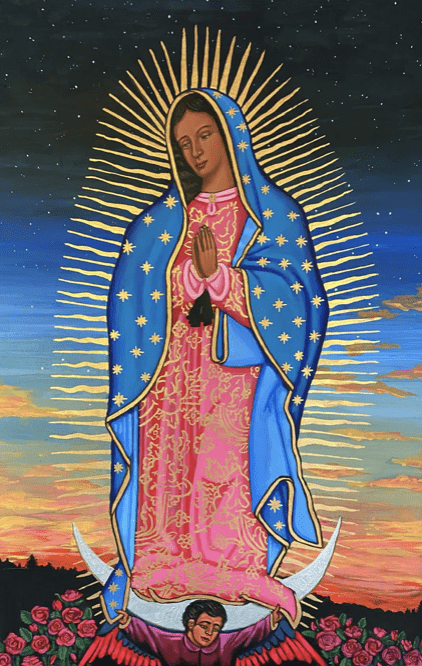
Icon by Kelly Latimore | Text by Shawn Allen
Nuestra Señora, my Mother, embrace me.
Touch my face my face with your gentle hand
and whisper that you are here,
you who are the Mercy of God,
you who reaches into my fears, my shame, my deepest wounds,
and there makes your home.
Surround me with your cloak of comfort
and let me rest.
Four centuries ago, on a cold December day, a Chichimec man named Juan Diego was climbing up a hill called Tepeyac near the village of Guadalupe, Mexico. He had just finished describing to his archbishop a vision he had experienced the last time he stood on this hill. In that vision, he met a mysterious woman calling herself Mary, the Mother of God. As he kept walking up the hill, he remembered the profound beauty of this Mary, who had announced herself in a gentle voice. But the archbishop wanted proof that his experience was more than just a dream, so here he was, returning to this place to get some sign that he could share. He reached the top of Tepeyac, worrying that Mary might be offended at his request and feeling the pressure of his archbishop’s demand. There, she appeared again, and again the words came deep and gentle to his ears: “¿No estoy yo aquí, que soy tu madre?” (“Am I not here, I who am your mother?”).
He basked in the all-encompassing comfort of these words. More words followed, as Mary asked him to collect roses from the hill and bring them to the archbishop as the sign he had sought. Again, Juan struggled with anxiety, as he was sure there were no roses to be found on Tepeyac in the winter cold. Nevertheless, he set out, determined to get the archbishop his proof. To his surprise, the hill was resplendent with roses, and he collected as many as he could in his tilma (or cloak) to bring with him on his journey down the hill.
When he arrived before the archbishop, he felt a jolt of excitement as he finally had a sign of the beauty he had experienced. He opened his tilma, and the roses tumbled to the floor. Juan thought the roses would be more than enough to convince the archbishop about the reality of his encounter, but he stood there, shocked to find much more. His tilma was no longer merely a cloak but now was home to an image of the Mary who had appeared to him. The brilliant colors of the image seemed to light up the room. Both Juan and the archbishop stared in wonder at this Mary with a mantle of aquamarine sparkling with stars and surrounded by rays of a bursting sun. She stood upon a crescent moon, and on her waist was a black ribbon, signifying the child she would soon bring into the world.
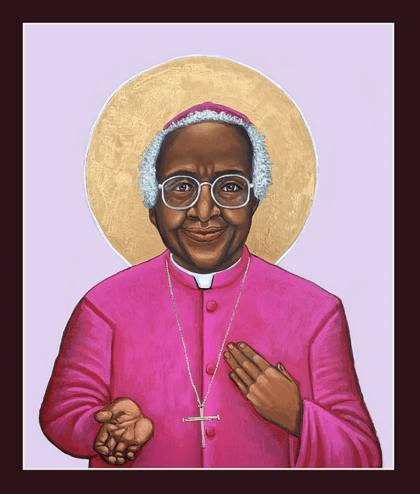
Icon by Kelly Latimore | Text by The Rev. Canon Carla Robinson
God of the suffering, never forget the lives of your poor, including me.
God of Truth and Reconciliation, let justice and compassion walk side by side in our broken societies, and in me too.
God of a man from South Africa, speak your life-giving word to the people of North America, and to my soul too.
God of the world turned upside down, hasten the day when the first will last and the last first, and turn my world upside down too.
God of generosity, you have opened your hand to us—offering and inviting, show us how to open our hands to each other.
God who sees, thank you for seeing me and loving me. Amen.
Desmond Mpilo Tutu (October 7, 1931–December 26, 2021) was a South African Anglican bishop and theologian. Tutu rose to prominence in the 1970s, becoming known for his work as an anti-apartheid and human rights activist as well as a strong advocate for non-violent resistance.
As Bishop of Johannesburg and later as Archbishop of Cape Town, he emphasized a consensus-building model of leadership. After Nelson Mandela was released from prison in 1990 the pair led negotiations to end apartheid and introduce multi-racial democracy. In 1996 Mandela selected Tutu to chair the Truth and Reconciliation Commission to investigate past human rights abuses committed by both pro and anti-apartheid groups. This became a model for restorative justice organizations used to this day.
Tutu was internationally praised for his activism, for which he won the Nobel Peace Prize and other international awards. Tutu spoke out on a wide range of subjects including the inclusion of women in the priesthood, gay rights, and Palestinian independence. His books and sermons continue to inspire people today.
He wears a cross made of nails,
recalling pain, hardness, sorrow, human suffering at the hands of other humans and death.
He has seen those things.
Despite what his eyes have seen, his lips smile.
What hidden thing in an old man brings this joy?
He gestures to his heart, maybe a clue?
The eyes look straight at you.
Not raised to heaven,
nor looking down from the height of sainthood.
He looks straight at you.
He reaches out to you
Offering you something? Inviting you into something?
Look deep into the eyes.
This son of Africa sees you.
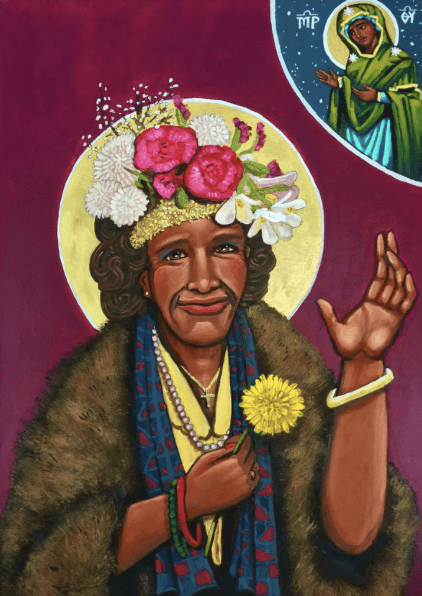
Icon by Kelly Latimore | Text by Miller Davis
I pray for peaceful community
unmolested by bigotry
to nourish my soul’s need
to touch other loving souls
and my body’s need
to touch other loving bodies.
I pray for courage
to defend the space needed
for that holy community
with my words and actions,
because my soul
and all souls,
my body
and all bodies,
deserve space to breathe
and be held
as Christ was held
by his disciples.
I pray for the souls,
the queer, black, brown
and indigenous souls,
who are murdered
in their pursuit of holy community,
as Marsha was
and as Christ was.
I ask to receive strength like theirs
to continue that pursuit.
Following Christ, who lifted a whip against the money changers in the temple, on June 28, 1969, Marsha P. Johnson lifted a brick against police oppression of the queer community at the Stonewall Inn in New York City.
In her own words:
History isn’t something you look back at and say it was inevitable. It happens because people make decisions that are sometimes very impulsive and of the moment, but those moments are cumulative realities.
Like Christ, Marsha cared for her community, founding STAR: Street Transvestite Action Revolutionaries with fellow trans woman Sylvia Rivera. This collective housed homeless queer youth and sex workers and defined itself as a revolutionary army against homophobia, racism, targeted incarceration, and harassment of queer and gender non-conforming individuals in prison and on the street. She later worked with ACT UP, the AIDS Coalition to Unleash Power, when her community was devastated by the AIDS pandemic.
I’ll always be known [for] reaching out to young people who have no one to help them out, so I help them out with a place to stay or some food to eat or some change for their pocket. And they never forget it. A lot of times I’ve reached my hand out to people in the gay community that just didn’t have nobody to help them when they were down and out.
Marsha’s death, like Christ’s, was the opposite of what she deserved. After years of activism and community building, she was found dead in the Hudson River, her death swiftly dismissed as a suicide, despite the protests of friends and family. In March of 2025, the Trump administration removed all information about Marsha P. Johnson and Sylvia Rivera from the National Park Service website for the Stonewall Inn, only weeks after removing any reference to transgender and queer individuals from the site. The Stonewall Inn was only recognized as a national monument in 2016—47 years after Marsha and others put themselves at risk to defend the dignity and rights of the LGBTQUIA+ community.
How many years has it taken people to realize that we are all brothers and sisters and human beings in the human race?
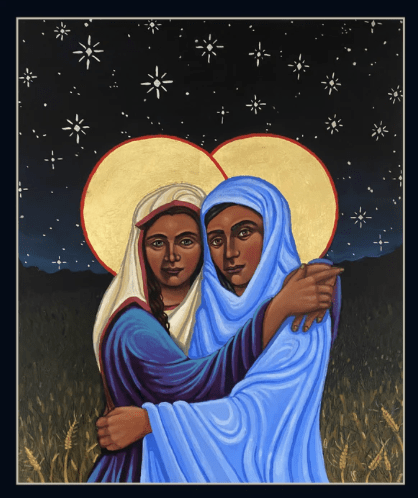
Icon by Kelly Latimore | Text by Meredith Moses
Mother Father God, Brother Sister God, at the beginning of time, you created families. Families intended to nurture, love and strengthen each other. But our world is broken and our families are often broken.
From the cross, Jesus created a new family when he said to his mother “Woman, here is your son.” and to the disciple whom he loved “Here is your mother.” —John 19:26-27
Sheltering God, create for us families—by birth, by circumstance, or choice—where we love, nurture, and support each other. Strengthen us to carry that love into the world.
This we ask in Jesus’s name. Amen.
Fate joined together
Love encircled, deep and still
Family of Choice
In the time when Israel was ruled by Judges, generations before David was king, Naomi and her family fled famine in Israel seeking a new life in a foreign country. The two sons married, and the family settled into life as immigrants.
Disaster struck: famine came to Moab, the men of the family all died, leaving Naomi and her daughters-in-law, Ruth and Orpah, widowed and destitute.
Hearing the famine in Israel had abated, Naomi planned to return. She instructed Ruth and Orpah to return to their families. Orpah went with Naomi’s blessing. But Ruth stayed with the Naomi saying:
“Where you go, I will go,
and where you stay I will stay.
Your people will be my people
and your God my God.” Ruth 1:16b
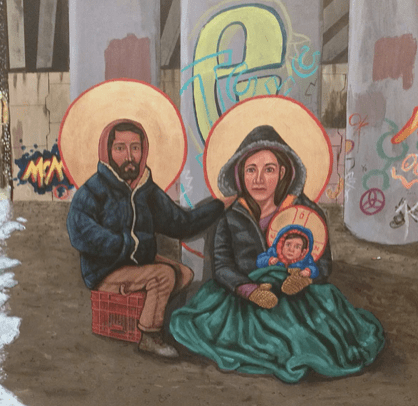
Icon by Kelly Latimore | Deacon Sally Carlson
GOD of All,
We trust you to guard and guide us in these times of uncertainty. We have no home to shelter us, warm us, or protect us from the elements. Our very lives are uncertain in these times. We are being sought by leaders eager to be rid of us. We are the shunned, powerless, and dispossessed ones. Sometimes Love feels out of reach for us. You promised with the birth of Jesus that you would love us through him forever. Help us to love and feel loved, O GOD, O Spirit, O Jesus, O Mary, mother of all mothers everywhere.
AMEN.
Mary, at the birth of her son Jesus, whispered to GOD:
“Our faith in your love brought us under your protection as we answered, “Yes” when you called through your angel messenger inviting us to be parents and family to Jesus. Here we are, Palestinians, in this unknown place, knowing you will hold us in your Love even as we must go to register with authorities in another unknown place for census counting. Keep us safe as we walk unfamiliar, crowded roads.”
Jesus and his parents, Mary and Joseph, were people of the street in their time. They were poor, without the mere basics of life, running from authorities eager to be rid of them. They were overtaxed and at the whim of a regime that would then decide their fate. They were people who didn’t belong, who perhaps feared death and deportation those two thousand years ago. The faith they had in GOD’s Love and request that they marry and raise Jesus; gave them the strength to stand by Jesus as his young life was cut short by over-zealous authorities with uncontested, silent approval from his own people.
Although Jesus was young at the time of his death, his impact has had repercussions throughout the ages on the whole world, and still today. He lives alongside us, guiding us through all the complexities of life. He knows our needs. He loves us perfectly throughout our lives—through our troubles, pains and joys—exactly as we were created.
This icon speaks to where Jesus might be in 21st century America.
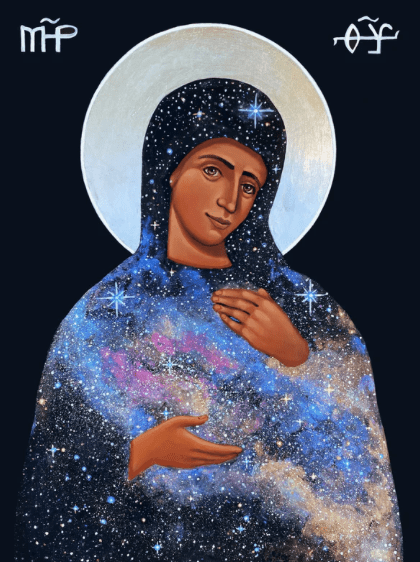
Icon by Kelly Latimore | Text by Deborah Bagg
Universal Mother, all people on Earth owe their cosmic origins and existence to you. The mountains and valleys of your stellar nurseries hold the elements that made us, and all of creation. Help us to recognize and show gratitude for this beginning, which we share with all living things. Help each of us honor and uphold our individual and common humanity, do our part every day to protect one another and our world and spread the light of your love. Amen.
Where do faith and science meet? Historically, the relationship between them has been one of enormous conflict.
With our current scientific and astronomical advances—particularly the Hubble and Webb telescopes—we are able to reach farther out in space, and further back in time, than our ancestors could have imagined possible. Science continuously sheds new light, giving us new ways of seeing our universe and contemplating our beginnings.
The writer Madeleine L’Engle saw faith and science as complementary ways of understanding. “When I look at the galaxies on a clear night,” she wrote in And It Was Good, “when I look at the incredible brilliance of creation, and think that this is what God is like, then instead of feeling intimidated and diminished by it, I am enlarged… I rejoice that I am a part of it.”
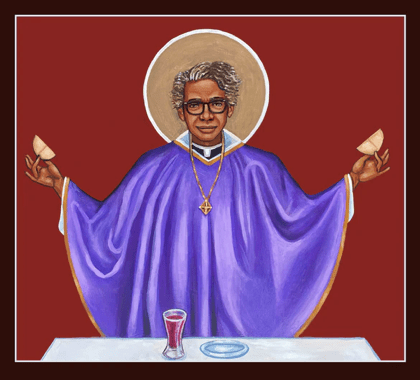
Icon by Kelly Latimore |
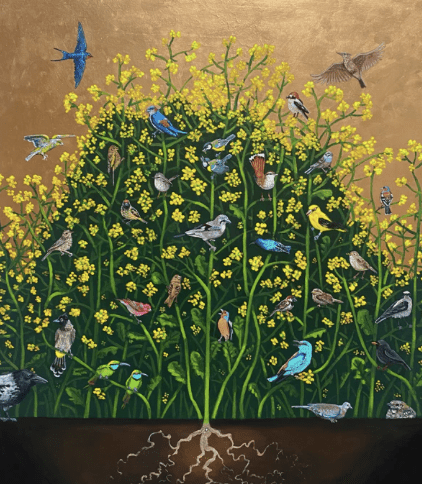
Icon by Kelly Latimore | Text by Miller Davis
He said therefore, “What is the kingdom of God like? And to what should I compare it? It is like a mustard seed that someone took and sowed in the garden; it grew and became a tree, and the birds of the air made nests in its branches.” (Luke 13:18-19, NRSV)
If you want to see
how God’s kingdom begins,
lie down on the dirt.
Wriggle across the moss—
be careful of slugs on the move
and soft, naked worms—
press your nose against
mulch and leaf litter
until pill bugs crawl
across your cheek.
Now look.
What connects the leaves
and fronds
and needles above you—
feathery structures
bearing nest and fruit
and the vault of the very sky—
to the earth,
nutrient-rich skin
of a rock hurtling through space?
The kingdom’s beginning
is a pale vein
sucking at death’s detritus
hoping to live:
a root
crooking its finger around
the possibility of life.
Thank you, God, for understanding
that we want so badly
to bring your kingdom to life
here on earth,
but often have no idea
where to begin.
Thank you for reminding us
that beginnings are often small,
that the first step
doesn’t have to be a mighty leap,
that the future begins
with a tiny seed
extending a tiny root.
Thank you for surrounding us
with living things
that provide food and shelter
for other living things,
and for a planet
that wants desperately
to heal itself.
Help us to be part of this
feeding,
sheltering,
healing cycle,
casting seeds of life and hope
as an active part of your kingdom.
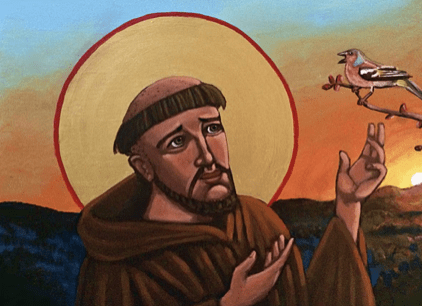
Icon by Kelly Latimore | Text by Tom Cashman
Dear Francis, you spoke with the birds just as the birds spoke with you about God’s love for every living creature. That carries me to hope for that same kind of connection with God though word and song. Help me to find my own voice of prayer. Show me how to join the great chorus of song and word expressing my love for God and for all of God’s creation—from birds to humans, algae to orcas. May my ears learn to hear God’s word—and song—in return.”
We know Francis as “the Saint of the Animals.” We recall that Francis addressed animals as “brother” and “sister,” reminding us of our call to love and protect—and listen—to all creatures. Many creatures that flew and crawled and swam were drawn to him, but especially the birds.
Francis is also known as the “Italian Celt” having taken his spiritual formation at a monastic community in Bobbio, Italy, one founded by Columbanus and his band of twelve missionary monks. Friendship and interaction with animals has always been a characteristic of the Celtic Saints, male and female.
In a time when the world seems less able to listen for our Maker in “The Great Conversation” of all beings, animals, forests, mountains and seas, may we quiet the noise of our human culture and reclaim our connection, our part in that Great Conversation.
Let me walk with you Francis. Teach me your ways.
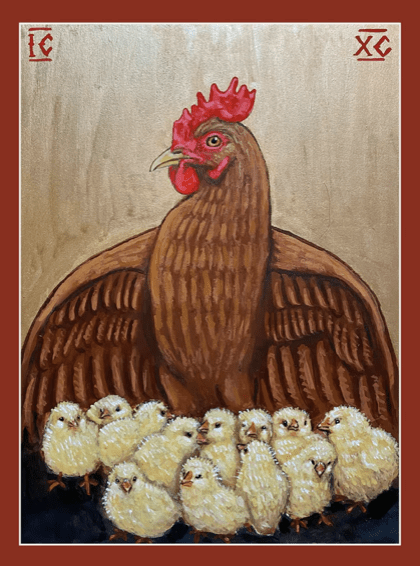
Icon by Kelly Latimore | Text by Miller Davis
Christ the Mother.
O Jerusalem, Jerusalem, the city that kills the prophets and stones those who are sent to it! How often would I have gathered your children together as a hen gathers her brood under her wings, and you were not willing! (Luke 13:34)
Jesus gathered his disciples,
his chosen family,
named them,
fed them,
told them they were powerful
and powerfully loved.
He told them stories
and answered their questions
about themselves and the world,
taught them selflessness
and wonder.
He took John’s hand and asked,
“Are you hungry?
Here, eat my body.”
He touched Peter’s arm.
“You look thirsty.
Here, drink my blood.”
What is a mother
but someone who wants
the best for you,
someone who offers
their sacrifice
over and over
in the face
of your refusal,
who sends message
after message—
I love you,
please do better—
despairing,
dying inside
over and over,
but never giving up?
Thank you, God,
for the mothering example
of Jesus Christ,
who spent so much of his ministry
feeding and holding space
for the humanity around him.
Thank you for the mothering
example of nature,
for hens and possums,
bears and seahorses,
nurse logs and saguaros,
and for the life-sustaining
environment of our planet.
Help us to value
the work of mothering
despite the sexist,
patriarchal impulse
to take it for granted,
to devalue it
as “woman’s work,”
when Christ’s example
and nature’s example
teach us mothering is work
we all must do.
Help us all to mother as Christ
and nature mother all of us.
Help us to feed the hungry,
to fight oppressors,
to shelter the unsheltered,
to build healing community,
and to value the identity
of every life we touch. Amen
Icon by Kelly Latimore | Text by Mark Fredericksen
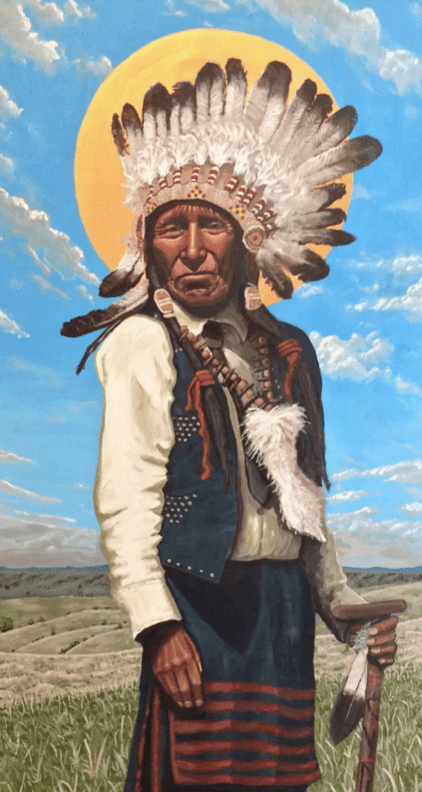
Gitche Manitou (Great Mystery),You have created two-leggeds and four-leggeds, plus all those who slither and swim out of supreme wisdom and your interconnection with us. Embrace all your life forms in knowledge of our roots in the earth, air, and seas. Grant us your Vision as we seek you and what is best for all. Aho.
Black Elk walked this world as a revered medicine man of the South Dakota Ogala Sioux tribe in the White man’s dating of 1863-1950. At the age of 9 he had a fever dream given to him by the Great Spirit that shaped a life vision of inclusion for the rest of his days. In the dream he travels around the world visiting other Spirit Chiefs: “I saw that the sacred hoop of my people was one of many hoops that made one circle, wide as daylight and as starlight, and in the center grew one mighty flowering tree to shelter all the children of one mother and one father. And I saw that it was holy.”
From him we learn of an abiding unity and connection between all beings on this planet. This vision remained with him even though he was wounded at Wounded Knee and endured life on the reservation. His iconic mark on the world is this reminder of our reverent place amidst the created order in all circumstances and with all beings and places.
Icon by Kelly Latimore | Lora-Ellen McKinney
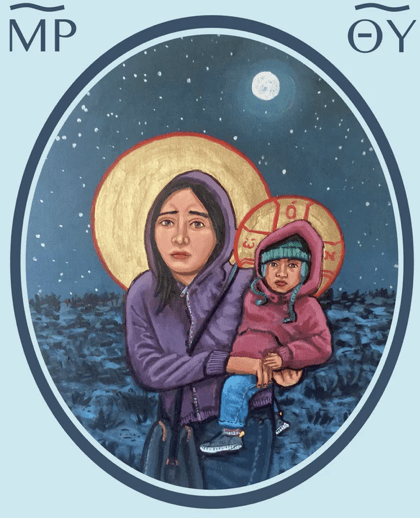
Kelly Latimore’s Our Lady of the Journey is part of a series inspired by a small statue known as La Peregrina (“The Pilgrim”), discovered at the Franciscan Novitiate community near California’s St. Ines Mission. Though little is known about the statue’s origins, the sisters lovingly referred to it as “Our Lady of the Journey,” a title that inspired Latimore to reflect on the countless journeys undertaken by the world’s women.
The icon presents Mary not only as the mother of Jesus, but as a companion to all who travel along difficult roads. She represents refugees seeking safety, women who walk long distances each day to obtain water or attend school, mothers searching for shelter, and families striving for more secure futures. In Mary’s face we see courage, endurance, and unwavering love.
The journey depicted in the icon is both physical and spiritual. Many women carry burdens that are unseen: grief, poverty, discrimination, violence, loneliness, or uncertainty. Some mourn the loss of loved ones. Others struggle to believe in their own strength while working multiple jobs, caring for children, or rebuilding their lives after hardship. Before any outward journey can begin, there is often an inward journey—the difficult work of hope, perseverance, and faith.
Latimore’s icon honors these women as bearers of dignity and resilience. Mary stands as a sign of God’s presence among those who travel through challenge. She reminds viewers that every step taken toward safety, justice, opportunity, and love is sacred. Our Lady of the Journey invites us to recognize the holiness found in ordinary acts of courage and the enduring power of a mother’s hope for her children.
Holy God,
You entrusted your Son to Mary, a young mother asked to carry a holy future she could scarcely imagine. You walked with her through uncertainty, danger, exhaustion, and hope, teaching her that she would never journey alone.
Be present now with mothers throughout the world: those fleeing violence, seeking shelter, gathering water, working long hours, grieving losses, or carrying burdens unseen by others. Remind them that every child entrusted to their care is precious, bearing dignity, promise, and your image.
Strengthen those whose journeys are measured in miles and those whose journeys are measured in courage. When fear overwhelms them, grant confidence. When resources fail, provide companions. When the road grows long, renew their hope.
Teach us to honor, protect, and support all who nurture the next generation, that every family may find safety, justice, and opportunity, and every child may flourish in love.
Through Jesus Christ, who journeyed among us as Mary’s child and the Savior of the world. Amen.
Icon by Kelly Latimore | Text by The Rev. Kevin Pearson
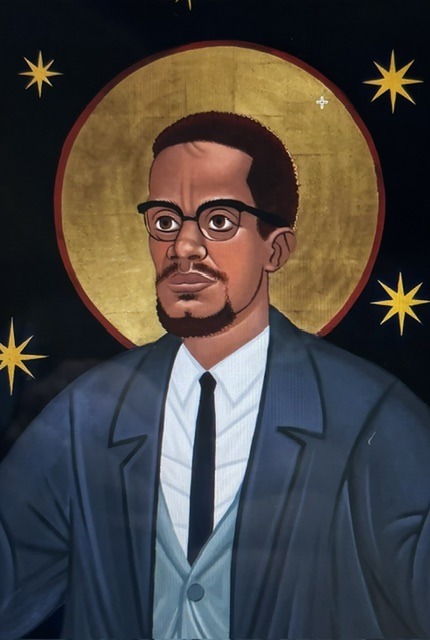
You, Malcolm, who lived knowing your life would be taken for the liberation of your people. HOLY be you name and your martyrdom. Speak your incisive clarity so I may stand tall and fierce in the face of injustice; lend me the wisdom of your soul spent over the arc of time. History turned because of your place in it. For that May Allah be praised. Amen.
Coming soon…
Icon by Kelly Latimore | Text by Lora-Ellen McKinney
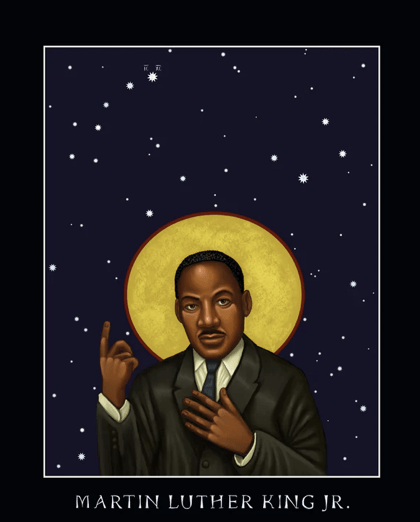
Oh God, our help yesterday, today, and tomorrow: May we every day remember the lessons of Jesus, so beautifully demonstrated by Your son, Martin Luther King.
Jesus teaches us to seek social cohesion—connections that bring equality to the least, the last, the locked up, the locked out, the left behind, and the lonely; to choose community over chaos; to remember that valor emerges in obedience to Your call to unleash the heroes in our own hearts.
God of our forebears, may we affirm unity and love, lift compassionate voices to the sky, and plant our feet in Your purpose. Help us acknowledge Martin’s sacrifice and commit to our own. Amen.
Martin Luther King didn’t think himself heroic. He feared known dangers. He faced unseen enemies. He knew that the mountain was his to climb, the Promised Land claimed but out of view.
Kelly Latimore’s icon presents Martin, the man. Not the titled and lauded King. Not the man who publicly prayed that skin color not limit the ambitions of his four children. Not the man who, in the roiling cadence of Black Baptist ministers, claimed access for his people to a mountaintop he knew he would not reach. Here, King is mortal.
Here, King is as he was: small in stature, tired, aware. Standing beneath God’s sky, he is free. At last. Above him is the North Star that led generations of his people to safety from enslavement. Martin points upward, where can be seen the Greek symbols for Christ, his king. He looks forward, imploring viewers to collaboratively seek space no longer accessible to him. In the world to either side of King, unseen, is the other side of the mountain, a slope that, with God’s grace and human perseverance, opens towards equity, inclusion, diversity, acceptance, and faith in God and one another.
Pointing towards the heavens that lit his path through the darkness and gathering strength from the North Star that once guided his people to freedom, King understood his sacred commission. King’s pedigree obliged that he confront injustice out loud. His pulpit required that he follow Christ’s revolutionary path into the unknown and unseen.
The blessings of the other side of the mountain are within our reach if we, like Dr. King, are willing to face chaos for Christ, to build God’s Kingdom in places we’d otherwise ignore. The poet James Weldon Johnson might have described King’s dogged fight for justice thusly: (He) ran a race from wood and stone to Christ.
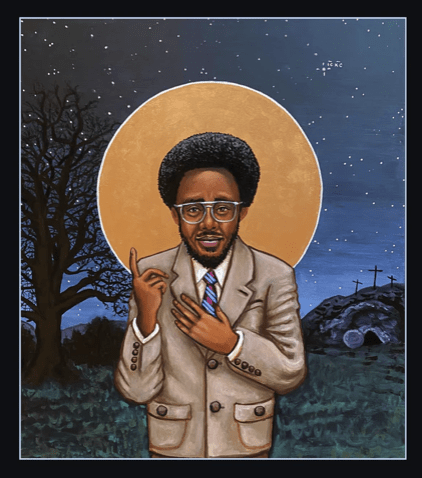
Icon by Kelly Latimore | Text by Fr. Kevin Pearson
You who would blush to be prayed to, prayed through, whose word through voice and pen carved space and place for your people and for all people, hear my cry, soak up my tears, heal and steel my soul and so help me stand to face the day of deliverance on the other side of this night of struggle. Thank you for the ground you held like Jesus holds. Amen.
Brother Cone holds a center place on this wall flanked by better-known figures—luminaries he introduced to generations of students at Union Theological Seminary in New York City, making sense of their witness to faith and society and their relationships to one another from the perspective of the Civil Rights era and beyond. Dr. Cone was known as the founder of Black Liberation Theology. His scholarship emerged from his life growing up in the Black Church tradition in the American South—a life of profound contradiction: continually embraced as part of the beloved community, and continually targeted as a Black leader fighting for justice for his oppressed people.
Dr. Cone’s penultimate book, The Cross and the Lynching Tree, reveals the saving importance of Jesus for oppressed people: how Jesus was lynched like so many Black men, as represented in the icon at far left, of a Black Christ being crucified.
Cone illuminated for his students, colleagues, and all of us the titanic contributions of Martin King and Malcolm X, whose icons appear, far right. Through their eyes and experience Cone taught us to understand the forces of separation and integration. How, separated by parentage and religion, they learned from and moved toward one another; how people and peoples must stand apart from others to share common experience and heal and stand against the tide; how people and peoples, when respected, can seek an authentic and greater brotherhood, sisterhood, and not before. Similarly, given the importance of grassroots organizers in Cone’s understanding of liberation theology, fitting that two of its front-line leaders appear here at Cone’s right hand: Fannie Lou Hamer and Bayard Rustin.
Fearless prophet and liberator of all peoples the American empire seeks to keep at the margins, James Cone was a ferocious and tenacious teacher, preacher, and scholar who never gave oppression an inch so that, like him, we could stand tall.
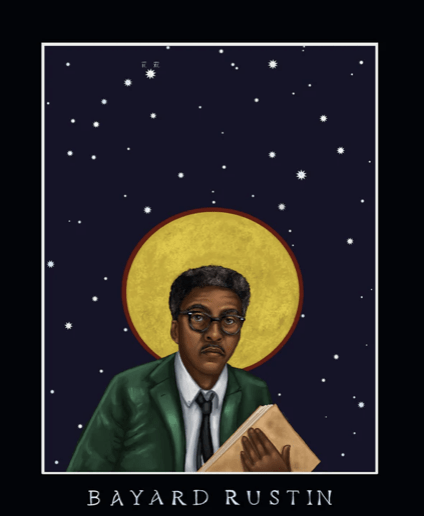
Icon by Kelly Latimore | Text by Rachael Rehberg
“God does not require us to achieve any of the good tasks that humanity must pursue. What God requires of us is that we not stop trying.”
“The only weapon we have is our bodies, and we need to tuck them in places so the wheels don’t turn.”
“We need in every bay and community a group of angelic troublemakers.”
—Bayard Rustin
Lord, bless those who organize protests and demonstrations fighting for civil rights for all. May they have the strength and patience to continue coordination efforts despite opposition.
Lord, grant me the strength to be an angelic troublemaker—to know when it is the right time to make good trouble—to agitate for better conditions for my fellow human beings.
Lord, protect me as I use my body in nonviolent ways to stop the wheels of injustice from turning. May I have the courage to continue my efforts despite setbacks and defeat, knowing that I am serving God through my continued attempts.
Bayard Rustin (1912–1987) was a prominent U.S. American civil rights leader, intellectual, and activist, who is perhaps best known for organizing the March on Washington, D.C. in August 1963, which brought some 250,000 people together to rally for civil rights and better economic conditions for Black Americans.
Rustin was strongly influenced by his grandmother, a Quaker, who believed in the dignity of all humans. Advocating for the rights of others became his life’s work. He organized his first protest in college over poor food conditions for students. His first job was to educate others about non-violent resistance techniques to fight injustice. Living by his own principles, he refused to register to serve in WWII and spent three years in a federal prison, where he fought for the desegregation of the prison system.
Rustin lived openly as a gay man in a time when homosexuality was considered immoral and illegal. His employers and mentors encouraged him to hide his sexuality so that he could gain greater career and political power. However, Rustin refused to hide his true identity. In 1953 he was arrested in California for having consensual sex with another man. This would later be used against him by both Republicans and Democrats in attempts to silence him and undercut his activist efforts.
In 1955, Rustin went to Montgomery, Alabama to advise then 25-year-old Dr. Martin Luther King, Jr. on non-violent strategies to aid the ongoing bus boycott. He encouraged Dr. King to get rid of his own guns and security guards. Seven years later, Rustin was tasked with organizing the March on Washington, where he managed logistics to ensure thousands of busloads of Americans were able to attend. Sadly, Rustin also organized the memorial march in Memphis following the assassination of Dr. King in 1968.
Posthumously, in 2013, President Obama awarded Rustin the Medal of Honor for his civil rights efforts. In 2020, California Governor Gavin Newsom pardoned Rustin from his 1953 gay sex conviction.
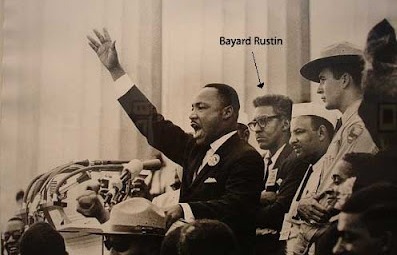
Sources:
Brother Outsider: The Life of Bayard Rustin. Directed by Nancy D. Kates & Bennett Singer, The American Documentary, 2003.
“Remembering Bayard Rustin on Dr. Martin Luther King Day.” Daughter Number Three, 19 January 2009. Link
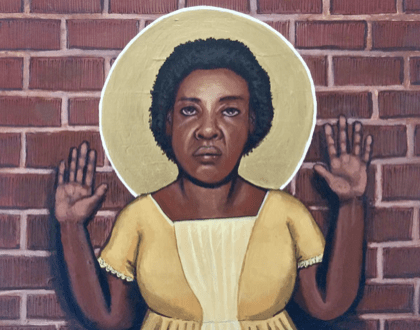
Icon by Kelly Latimore | Text by Robert Davis
God of justice,
of real justice
for the marginalized
and the oppressed:
Help me to remember
of every person
that their worth, and my worth,
their dignity, and my dignity,
their importance, and my importance,
their potential, and my potential,
do not depend on
housing,
employment,
education,
citizenship,
documentation,
health,
ability,
wealth,
status,
or power.
Help me to remember
that having any or all of these things,
or having none of these things,
says nothing about whether
a person is
loving,
patient,
honest,
empathetic,
compassionate,
generous,
kind,
merciful,
wise,
brave.
Help me to remember
that true peace requires
justice for all.
Help me to do
whatever I can
to bring peace with justice
where I am. Amen.
Civil rights activist Fannie Lou Hamer was a plain-spoken woman. With her Black southern vernacular and 6th grade education, she did not fit the stereotype of a great orator, but she commanded a crowd’s attention just the same. She was known for telling it like it was. Shaped by a life in which she picked cotton from age six, took and re-took unfair literacy tests and paid unfair poll taxes to be able to vote, was arrested and sexually assaulted and beaten nearly to death by police, underwent forced sterilization, and was repeatedly targeted by white supremacists in drive-by shootings, she famously said, “I am sick and tired of being sick and tired.” Even so, she never gave up the struggle, always fluently connecting the Biblical call for liberation with the lived injustices of American society, and even running for Congress.
As Hamer put it, “We been waitin’ all our lives, and still gettin’ killed, still gettin’ hung, still gettin’ beat to death. Now we’re tired waitin’!”
She was proud, confident, funny; she was nobody’s fool; and she was a visionary. She ultimately founded a farm co-op that not only improved the nutrition and economic prospects of poor Black families, but also grew to become an alternative source of financing for their homes, businesses, and educations.
Reflecting on her defiance of the white power structure, she said, “I guess if I’d had any sense, I’d have been a little scared—but what was the point of being scared? The only thing they could do was kill me, and it kinda seemed like they’d been trying to do that a little bit at a time since I could remember.”
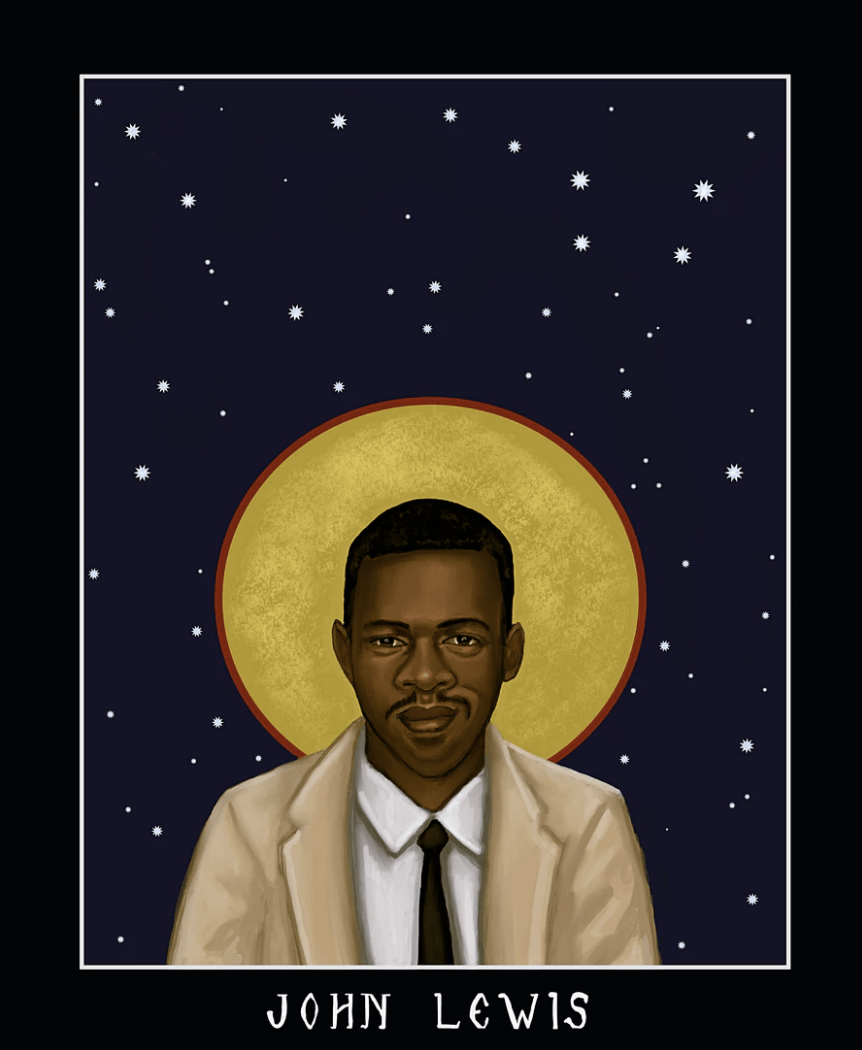
Icon by Kelly Latimore | Text by Mary Fancher Butler
Holy and Gracious One, we give thanks for John Lewis and all those who work to protect human rights, secure civil liberties and build the beloved community. We pray that we would love and care for our neighbors as John Lewis loved and cared for his chickens and all people, that we would seek out paths of peace and collaboration and commit to a life of nonviolence. May we have the courage to resist and defy that which is morally wrong. May those who get into good trouble be safe and nourished. Together may we create beloved community where all people live in peace. Amen.
The parents of John Lewis (1940–2020) were Alabama sharecroppers. He recalls as a little boy, “We had many chickens and I loved them. I would preach to them and give them care”. He attended segregated schools and as a teenager met Rosa Parks and Martin Luther King, Jr. While attending seminary he committed himself to “nonviolence as a way of life” and dedicated his life to protecting human rights, securing civil liberties, and building “the beloved community” where all would live in peace.
In contemplating John Lewis’ life, ask:
What opens your heart?
What people and issues formed you?
What values anchor your life?
John Lewis participated in and led numerous nonviolent efforts and marches. In response to denied voting rights, he led a march from Selma to Montgomery that was interrupted by Alabama state troopers who brutally attacked the marchers; that march became known as “Bloody Sunday.” Although he was arrested over 40 times and bloodied and beaten many times, he maintained his steadfast commitment to his values. Revered for his courage, he said, “Courage reflects something deep within the man, woman, or child who must resist and defy an authority that is morally wrong. Courage makes us march on despite fear and doubt on the road toward justice. Courage comes from a divine purpose to make things right.”
What undergirds John Lewis’ courage? Yours?
John Lewis is famous for saying, “Never, ever be afraid to make some noise and get in good trouble, necessary trouble.”
What’s an example of good and necessary trouble today?
John Lewis served in the United States House of Representatives for Georgia’s 5th Congressional district from 1987 until his death, being reelected 18 times. Yet he said, “If any radical social, political, and economic changes are to take place in our society, the people, the masses, must bring them about.”
What needed change calls to you?
What is a first step you could take?
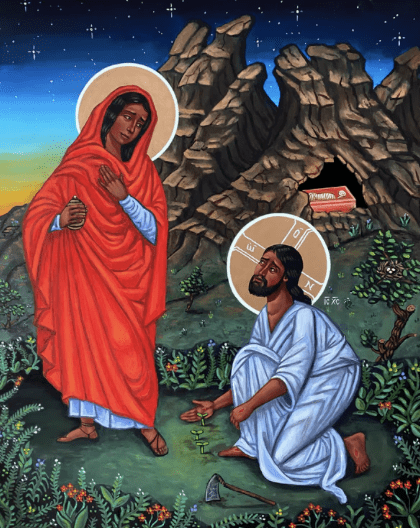
Icon by Kelly Latimore | Text by Robert Davis
“I See Trees”
Poem by Miller Davis
There is a bird
who lives in a traffic light
near the building
where I work.
I laughed
at first, at her
goings out and comings in,
until I realized
that she saw trees
where I did not.
In the Gospel of John, Mary Magdalene returns to a garden and finds that Jesus’s tomb there is empty. She sees Jesus, risen from the dead, but mistakes him for a gardener—until she hears him say her name.
They knew and loved each other so well that he said her name like no one else.
Maybe Mary didn’t recognize Jesus at first just because she had seen him die days before. Maybe he was obscured by the glare of early morning sun low in the sky behind him. Maybe, in true gardener fashion, he was obscured with dirt from working in the earth since first light.
But then he revealed himself—and how delighted he must have been to see her face dawn with recognition! Then like the birdwatcher in the poem, Mary realized there was life, after all, even when and where she had not expected it.
Mary had thought she would be caring for his dead body, but his body did not need her care. Instead, she could join him in caring for new, living, growing things.
Source of all life and goodness,
to whom all things are connected,
in whom all things are united,
by whom all things are loved,
when times are hard,
when joy is scarce,
when hope fades,
help us.
Speak our names.
Show us trees.
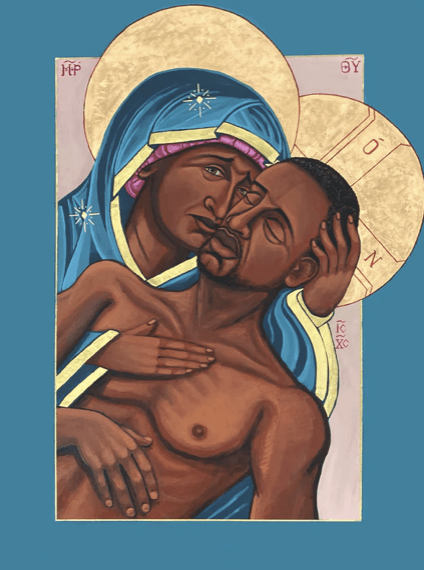
Icon by Kelly Latimore | Text by Lora-Ellen McKinney
Hear our prayer, Lord of unexpected messengers—
of carpenter’s sons and daughters … unhoused souls …
those wounded in spirit … all scattered and sacred pieces of you.
A world flying apart converged on a dirty Minneapolis street Memorial Day weekend 2020 where lay George Floyd, a 46-year-old Black man, an imperfect, unexpected messenger, murdered on television by an officer tasked with his protection. Dying on Gethsemane’s hill, Jesus is mocked as he dies. Floyd, too, is mocked as he dies pinned to concrete—asphyxiated—while calling for the loving arms of the mother who’d preceded his passage to You. His dying words undeniable contrast to the malice imposed on him in the form of uniformed knees, all his dreams constrained.
Blessedly Your grace shone through evil’s face. George taught us to morph our colonized spirits into consecrated sacristies where we can clothe ourselves in Your righteous armor. He helped us turn pain into purpose so that the people of God might proclaim a universal truth: made in Your image, we are sullied souls and broken vessels, worthy of respect, now reclaimed, redeemed, and risen.
The choir sings, The Jesus in me loves the Jesus in you, a reminder that we’re made in God’s image, commissioned by God to love one another as Jesus befriended those shunned by society, seeing holiness in every person.
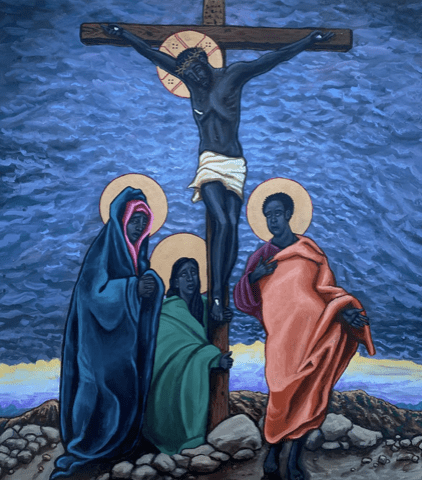
Icon by Kelly Latimore | Text by Don Burnett
Holy One, as I reflect in this courtyard on this icon and listen for your Voice, may this be for me a bridge between what I think is seen and what your Spirit might reveal to me. May I be listening to your invitation to become part of the “beloved community” given life out of the death of your Son.
Sitting at the feet of The Crucifixion icon with my young granddaughter gave me new eyes to see.
As you meditate or reflect on this icon, perhaps your eyes will see and experience a new perspective on the outworking of faith. This courtyard is often a “thin place” for me bridging what is seen to what is unseen.
Yes, there is a halo shared by Jesus, the two Marys and John. These circles of light are the way icons designate sainthood. Sure enough, the luminance of the radiant light around their heads is vivid in contrast to their black skin. (I saw the black skin; my granddaughter saw the light!) The light of the suffering Christ equally illumines the women and the man – all at the foot of the cross.
My grandchildren are exposed to a rich diversity of people as they grow up in home, schools, and church and notice where respect and dignity are expressed and where they are not. Together we see the adjacent banner reading “Black Lives Matter” and see it’s meaning visually expressed in the Crucifixion scene and in the new humanity birthed at the foot of the Cross.
The conversation got personal. The figures gathered about Jesus came into focus. The biological relationship of Son of God to Mother of God became full of light and mystery. The relationship between Jesus and John, the Beloved Disciples invited us into a pattern of light following the “way of love.” This way of love is embodied in the lines in the story where Jesus said “Mother see your child.” He said to John, “see your mother.” (John 19:26)
Here at the foot of the cross. Here in the courtyard of St. Luke Church. Here in Renton, there is a new kind of community being revealed. The new creation out of the suffering and the risen One is giving us life out of death. This we celebrate when we celebrate the Eucharist:
Christ has died Cristo ha muerto
Christ is risen Cristo ha resucitado
Christ will come again Cristo volverá
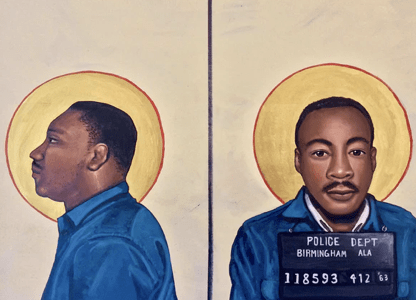
Icons by Kelly Latimore
Text coming soon
Icon by Kelly Latimore | Text by Lora-Ellen McKinney
Kelly Latimore’s “Our Lady of the Journey” is part of a series inspired by a small statue known as La Peregrina (“The Pilgrim”), discovered at the Franciscan Novitiate community near California’s St. Ines Mission. Though little is known about the statue’s origins, the sisters lovingly referred to it as “Our Lady of the Journey,” a title that inspired Latimore to reflect on the countless journeys undertaken by the world’s women.
The icon presents Mary not only as the mother of Jesus, but as a companion to all who travel along difficult roads. She represents refugees seeking safety, women who walk long distances each day to obtain water or attend school, mothers searching for shelter, and families striving for more secure futures. In Mary’s face we see courage, endurance, and unwavering love.
The journey depicted in the icon is both physical and spiritual. Many women carry burdens that are unseen: grief, poverty, discrimination, violence, loneliness, or uncertainty. Some mourn the loss of loved ones. Others struggle to believe in their own strength while working multiple jobs, caring for children, or rebuilding their lives after hardship. Before any outward journey can begin, there is often an inward journey—the difficult work of hope, perseverance, and faith.
Latimore’s icon honors these women as bearers of dignity and resilience. Mary stands as a sign of God’s presence among those who travel through challenge. She reminds viewers that every step taken toward safety, justice, opportunity, and love is sacred. “Our Lady of the Journey” invites us to recognize the holiness found in ordinary acts of courage and the enduring power of a mother’s hope for her children.
Holy God,
You entrusted your Son to Mary, a young mother asked to carry a holy future she could scarcely imagine. You walked with her through uncertainty, danger, exhaustion, and hope, teaching her that she would never journey alone.
Be present now with mothers throughout the world: those fleeing violence, seeking shelter, gathering water, working long hours, grieving losses, or carrying burdens unseen by others. Remind them that every child entrusted to their care is precious, bearing dignity, promise, and your image.
Strengthen those whose journeys are measured in miles and those whose journeys are measured in courage. When fear overwhelms them, grant confidence. When resources fail, provide companions. When the road grows long, renew their hope.
Teach us to honor, protect, and support all who nurture the next generation, that every family may find safety, justice, and opportunity, and every child may flourish in love.
Through Jesus Christ, who journeyed among us as Mary’s child and the Savior of the world. Amen.
Icon by Kelly Latimore | Text by Lora-Ellen McKinney
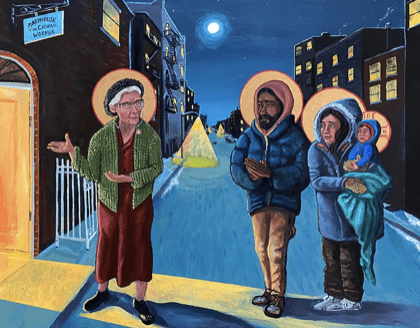
In this contemporary icon, artist Kelly Latimore places Dorothy Day in the streets of New York City, where she devoted her life to serving people living in poverty. At the door of a Catholic Worker house of hospitality, Day encounters a homeless family: Mary, Joseph, and the infant Jesus.
The scene reimagines the biblical story of the Holy Family seeking shelter. Instead of arriving at an inn in Bethlehem, they appear as unhoused people in a modern city. Dorothy Day stands ready to welcome them, embodying her lifelong commitment to hospitality, justice, and human dignity.
The icon invites viewers to see Christ in those who are often overlooked, excluded, or dismissed. Day believed that every person bears the image of God and that caring for those in need is central to the Christian life. The image reflects her conviction that refusing to recognize the divine image in another person is a denial of the mystery of the Incarnation—God becoming human in Jesus.
Through warm colors, familiar urban surroundings, and sacred symbolism, the icon bridges the distance between biblical history and contemporary life. It challenges viewers to ask who is welcomed, who is turned away, and where God might be found today.
“Dorothy Day and the Holy Family of the Streets” reminds us that holiness is often encountered at the margins of society and that acts of compassion can become sacred encounters. In welcoming the stranger, we may discover that we are welcoming Christ himself.
God of every doorway and every street,
You came among us not in power but in vulnerability, seeking welcome in a world that often turns seekers away. In Dorothy Day, you revealed a heart open to the stranger and a faith that recognized your image in every person.
Grant us eyes to see Christ in those who are unhoused, hungry, lonely, ostracized, or forgotten. Give us courage to offer hospitality, to seek justice, and to welcome one another with compassion and dignity.
That our communities may become places of refuge and belonging, where your love is made visible in the world.
Amen.
Icon by Kelly Latimore | Text by Lora-Ellen McKinney
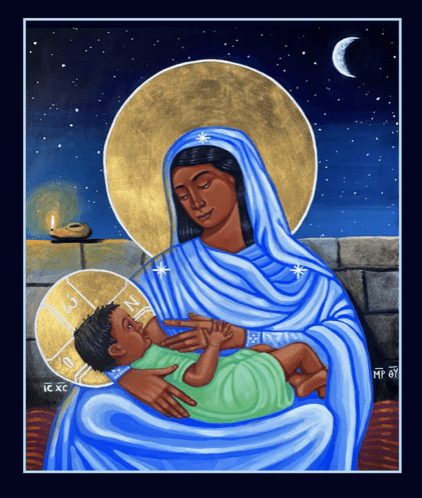
Kelly Latimore’s icon of Mary breastfeeding the infant Jesus presents a tender and deeply human image of the Incarnation. Rather than depicting Christ as distant or triumphant, the icon reminds viewers that God entered the world as a vulnerable child who depended completely upon the care of his mother.
For centuries, Christian artists have portrayed Mary nursing Jesus, often under the title Maria Lactans—Mary the Nursing Mother. These images affirm a central Christian belief: that Jesus was fully human as well as fully divine. He experienced hunger, dependence, growth, and the ordinary needs of infancy. The nourishment Mary provides is both physical and symbolic, revealing God’s willingness to share fully in human life.
The icon also honors the sacred vocation of caregiving. Mary is shown not as a queen on a throne but as a mother engaged in the daily work of sustaining life. Her actions reflect the countless parents, grandparents, foster parents, guardians, and caregivers whose love is expressed through ordinary acts of feeding, comforting, protecting, and nurturing.
At a time when the human body is often viewed with discomfort or suspicion, the icon proclaims the goodness of creation. The breast that nourishes a child becomes a sign of God’s abundance and care. The relationship between mother and child reveals divine love expressed through tenderness, trust, and mutual belonging.
Ultimately, this icon invites contemplation of a God whose touch is personal. In the nursing Christ Child, viewers encounter a Savior who began life as every human being begins: dependent upon another’s love. Through Mary’s nurturing embrace, the icon celebrates the holiness of motherhood, the dignity of the body, and the mystery of God dwelling among us.
Holy God,
You chose Mary, young in years and rich in courage, to carry your love into the world. She fed your Son from her own body and learned that extraordinary callings are lived through ordinary acts of care.
Bless all who nurture life: parents of every kind, grandparents, foster parents, guardians, teachers, and all who stand watch over the young. Be strength for the weary, companionship for the lonely, and hope for those who cannot yet see the road ahead.
Remind us that every child is sacred, bearing your image and promise. Following Mary’s example, may we nourish one another with compassion, encouragement, justice, and hope, helping all people grow in dignity, wisdom, and love; through Jesus Christ our Lord. Amen.
Icon by Kelly Latimore | Text by Robert Davis
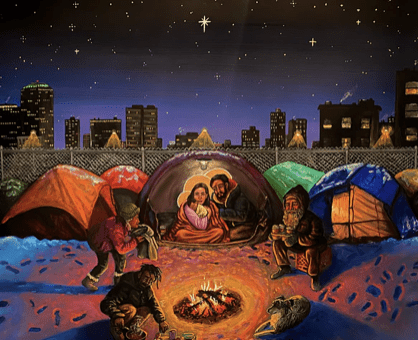
To you who are reading this:
If you are unhoused, you know what it is like.
Even if you are currently housed, maybe you have experienced what it is like to not know where to go, to not have a safe place to be, to be unable to rest.
Have you ever been evicted?
Slept in a car?
Slept wherever you could find a place?
Have you ever had to leave with only what you could carry?
If you have never experienced any of these, you are fortunate.
Imagine it happening to you.
Coming home from work, you find the locks changed and your possessions on the curb. Beds, clothes, television. Maybe some of it has already been scavenged by passersby. You knew you were behind on rent, but thought you still had some time. You work so hard but money is so scarce.
Maybe your kids are there, locked out, waiting for you. Weeping. They came home from school and couldn’t get in. Their beloved bike is gone.
You can take only what will fit in your car. And you need room for everyone to sit. Maybe room to sleep. Can you afford a night in a hotel?
What about the night after that?
The night after that?
Many shelters are full. Many can’t accommodate families.
What do you do?
A tent and some sleeping bags. Yes. You can charge that. In a tent city, other people will be there, who already know how to live this way.
They will help you.
You have worries. You know that sometimes encampments are cleared by the authorities. Sometimes everything a person owns in the world ends up in a dumpster.
But you’re hanging on.
You can keep your family together.
You always have.
You can rebuild.
You always have.
You will rebuild.
The safety and kindness of new neighbors give you hope.
Sheltering God,
forgive me for all the times when I look the other way,
the times when I imagine that the hardships of others are not my own.
Help me, help all of us,
to change our society.
May it not be this kind of place—
a hell that throws human beings away.
Icon by Kelly Latimore | Text by Sharon Johnson
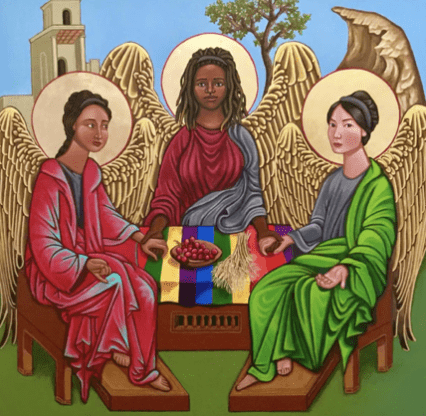
Three-Person God, open my eyes, my ears, my heart
to every human being … every lifeform … every habitat,
atmosphere, and force of nature.
Three-Person God, encircle me … surround me with grace …
fill my empty places with your love.
Three-Person God, help me care for and respect all that you
have entrusted to us.
May it be so
ever and always.
Amen.
Twenty centuries ago,
theologians suggested we think of God
as a Trinity—three divine persons in one—
persons who came to be called Father, Son, and Holy Spirit—
perhaps to express
God’s infinite wisdom | God’s transcendence | God’s continued presence
in the world, in our lives.
How might we re-imagine the Trinity today?
Perhaps—
WOMEN OUR CULTURE PUSHES TO THE MARGINS. Women who might be indigenous … Indian, African, and Asian … neighbors who need our help.
Perhaps—
God’s invitation to each of us: CREATE, HEAL and BE A RIVER OF GRACE in this world. Now. Today.
Perhaps—
3 persons who remind us we are here to CONNECT & CARE FOR & RESPECT ourselves … those we know … those we have yet to meet … the entire biosphere.
Icon by Kelly Latimore |
Text coming soon
Icon by Kelly Latimore | Text by Matthew Frazier
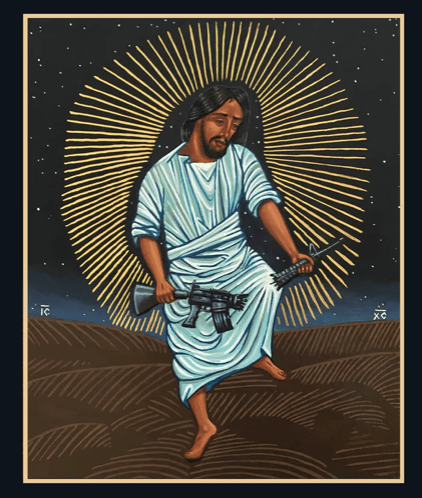
Creator of All—Our best and brightest are so frequently beguiled by egotistical pursuits. Driven by fear, greed, and the promise of power, we toil under these same heavy burdens. Forgive us for seeking to be always more and to have always more; for protecting ourselves while harming others; for increasing destruction while decreasing in humility. We have been out for dominance and by placing our selves at the center of everything, others became collateral damage. Change us.
Neither a violent nor non-violent act, the motion and posture of Jesus seems to suggest a dance. With a slight, wry grin, Jesus is possibly even enjoying a bit of fun in this supernatural act of destroying a modern weapon with his own hands. While Jesus knows the unspeakable pain that such weapons of war cause, he embodies the release of that pain while also putting an end to gun violence altogether.